

Introduction
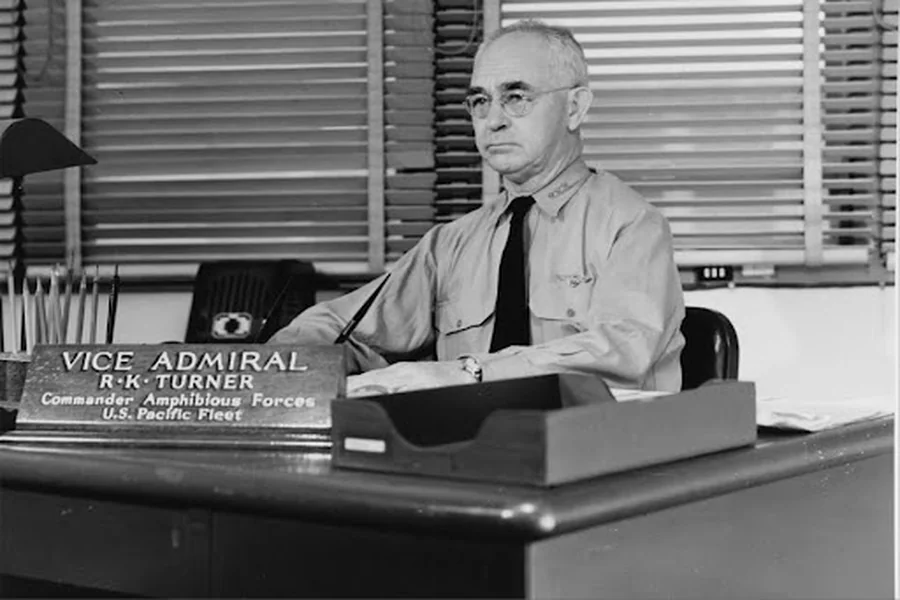
Each October, the U.S. Navy celebrates the anniversary of its founding in 1775. The Navy Birthday is more than a ceremonial date—it is a chance to remember the people who shaped naval power into a force that protects freedom on and off the seas. Among those people stands Admiral Richmond Kelly Turner, the hard-driving strategist whose mastery of amphibious warfare helped secure the Allied victory in the Pacific. His life tells the story of a Navy that reinvented itself for modern war, and of an officer who demanded excellence because he knew hesitation cost lives.
Turner was born in Portland, Oregon, in 1885 and raised in Stockton, California, in a family with no special ties to the sea. He entered the U.S. Naval Academy in 1904, graduating in 1908 and serving on surface ships, in engineering billets, and later in naval aviation. That range of assignments gave him deep technical knowledge, but it was his restless mind and insistence on precision that set him apart. Even before World War II, he showed signs of the intense planner he would become, teaching at the Naval War College and arguing that any future Pacific conflict would depend on intricate coordination between ships, planes, and ground forces.
Mastermind of Amphibious Warfare
Those ideas turned out to be prophetic. After Japan attacked Pearl Harbor, Turner was tapped to help design and lead some of the most complicated operations in naval history. He was instrumental in planning the first major U.S. offensive of the war, the landings on Guadalcanal in August 1942. Amphibious warfare was still an unproven art, and success depended on the kind of minute preparation he relished: the loading of every transport ship, the scheduling of naval gunfire, the exact timing of Marine landings, the establishment of supply routes under fire. When Japanese aircraft and surface ships counterattacked, Turner’s discipline and quick adjustments helped keep the Marines supplied and the beachhead secure.
From there, his responsibilities only grew. Turner oversaw amphibious forces in the Central Pacific drive, including the bloody assaults on Tarawa, Saipan, Guam, and finally Okinawa. These operations required him to coordinate hundreds of ships and hundreds of thousands of sailors and Marines, often across thousands of miles of open ocean. He pioneered the use of Underwater Demolition Teams—the forerunners of today’s Navy SEALs—to clear landing zones. He pushed for improved naval gunfire support and refined logistics so that every wave of troops and supplies arrived when and where they were needed. Behind the headlines of victory lay a staggering level of detail that he personally monitored, from the dimensions of landing craft to the timing of artillery barrages.
Discipline as a Form of Protection
Turner’s leadership style was as formidable as the missions he directed. Known as “Terrible Turner,” he was famously demanding and sometimes abrasive. He worked long hours, expected the same of others, and had little patience for carelessness. To those under his command, it could feel relentless. Yet many who served with him later said his severity came from a desire to save lives by eliminating avoidable errors. After the costly battle of Tarawa, he insisted on new procedures to prevent friendly-fire incidents and to improve communications between ships and shore units, even when that meant slowing operations. He believed that precise planning and tough standards were acts of protection, not just discipline.
Turner’s accomplishments went well beyond the fighting itself. By perfecting the Navy’s ability to project power ashore, he helped define how the United States would conduct large-scale amphibious operations for decades. His concepts—integrating naval gunfire, carrier aviation, logistics, and ground forces into a single plan—became the blueprint for modern expeditionary warfare. The Navy’s ability to carry out complex humanitarian and combat missions around the world today still rests on lessons first hammered out under his command.
The personal cost of this service was high. Turner bore the stress of continuous operations, the weight of knowing that every oversight could mean hundreds of lives lost, and the isolation that comes with ultimate responsibility. His marriage to Harriet Sterling faced long separations and the constant anxiety of war. After the conflict, he continued to serve, but declining health and the deaths of close family members darkened his later years. He died in 1961, only months after his wife, leaving behind both a storied record and a reminder that the burdens of command do not end with peace.
For the Navy, Turner’s career captures the essence of what this birthday commemorates. The Navy is not only a fleet of ships and aircraft; it is a living institution built by people who adapt to new technologies and new kinds of conflict. In World War II the service had to transform from a battleship-centered force to one capable of far-reaching amphibious warfare. Turner was one of the architects of that transformation. He proved that the Navy’s mission is as much about foresight and coordination as it is about firepower.
Remembering Richmond Kelly Turner on the Navy Birthday means seeing beyond the battles to the qualities that made victory possible. It means honoring a mind that fused strategy with logistics, a will that refused to accept half measures, and a commitment to his sailors and Marines that drove him to demand the best. It is a reminder that freedom is not preserved by improvisation alone. It requires years of preparation, relentless attention to detail, and leaders who are willing to carry the moral weight of their decisions.
Conclusion
Today, when U.S. Navy ships named for battles and heroes sail across the world, they reflect Turner’s influence. Every carefully planned amphibious exercise, every joint operation that brings ships, aircraft, and Marines together, owes something to the standards he set. His story is a fitting tribute for the Navy’s birthday because it shows what the service at its best can accomplish: not just victory at sea, but the ability to land and sustain forces anywhere freedom is threatened.
